Kard. Grzegorz Ryś w Maroku w 40. rocznicę spotkania Jana Pawła II z młodymi muzułmanami
25/03/2026 | Na stronie od 29/03/2026
Źródło: Archidiecezja Krakowska{.target_blank
Wciąż mamy czas, by przekazać jego naukę nowemu pokoleniu młodzieży
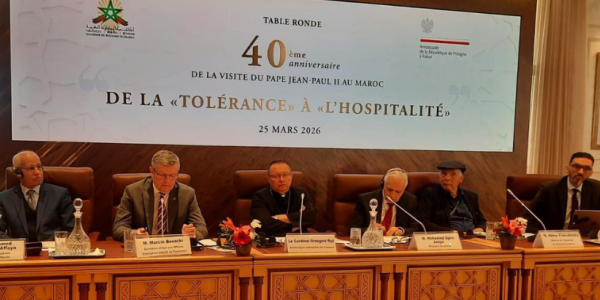
Na modlitwę i wspólną pracę, jako najważniejsze elementy budowania wspólnoty między muzułmanami a chrześcijanami w historycznym przesłaniu Jana Pawła II w Casablance zwrócił uwagę kard. Grzegorz Ryś, przebywający z wizytą w Maroku.
Kard. Grzegorz Ryś gości w Maroku, gdzie wziął udział w spotkaniu z okazji 40. rocznicy historycznego spotkania Jana Pawła II z 80 tysiącami młodych muzułmanów, które miało miejsce 19 sierpnia 1985 roku na stadionie w Casablance. Wówczas było to pierwsze w dziejach masowe spotkanie papieża ze światem islamu. Metropolita krakowski zauważył, że wszyscy komentatorzy tamto wydarzenie uważają za bezprecedensowe, a kard. Stanisław Dziwisz, ówczesny osobisty sekretarz Ojca Świętego określił je mianem „proroczego”. Kard. Ryś zwrócił uwagę, że z dokumentów historycznych wynika, że Jan Paweł II przemówienie do młodzieży przygotował osobiście, a sama jego treść wskazuje, że było „bardzo osobistym świadectwem”.
W swoim wystąpieniu metropolita krakowski zastanawiał się nad źródłami tamtego papieskiego przesłania. Zaznaczył, że raczej nie pochodziły z „okresu krakowskiego”, ponieważ jako arcybiskup krakowski, Karol Wojtyła nie miał zbyt wielu kontaktów z muzułmanami. Kard. Ryś zauważył, że dla papieża ważnym elementem polskiego dziedzictwa były jej wielonarodowość, wielokulturowość i wieloreligijność od XIV do XVIII wieku. Przypomniał też, że kard. Wojtyła podczas Soboru Watykańskiego II brał udział w ważnych dyskusjach, m.in. tych dotyczących wolności religii i sumienia. Przytoczył fragmenty dwóch jego wystąpień na ten temat. W jednym z nich przyszły papież podkreślił, że osoba ludzka stanowi cel wszelkich regulacji społecznych, a w tym kontekście „ma prawo wierzyć i wyznawać swoją religię”. W drugim fragmencie Karol Wojtyła podkreślał różnicę między tolerancją religijną a wolnością religijną – tolerancja jest tylko „częściowa i negatywna”, a wolność oznacza prawdziwy, osobisty wybór, pełen miłości. Kard. Grzegorz Ryś zauważył, że obie kategorie można znaleźć w przemówieniu papieża do młodzieży w Casablance. – Jan Paweł II używa słowa „tolerancja” tylko dwa razy; ale znacznie więcej mówi o „braterskich więziach”, „dialogu”, „miłości”, „miłosierdziu” i „współpracy” między chrześcijanami a muzułmanami. I oczywiście podkreśla priorytet osoby ludzkiej. (…) Każdy człowiek jest wyjątkowy w oczach Boga – mówił metropolita krakowski.
Zaznaczył, że owocem dyskusji o wolności religijnej na Soborze był rok później szereg deklaracji soborowych, w tym Deklaracja o stosunku Kościoła do religii niechrześcijańskich Nostra aetate, ogłoszona przez Pawła VI 28 października 1965 roku. Kardynał zauważył, że wszystkie cytaty w przemówieniu papieża w Casablance pochodziły właśnie z tego dokumentu. To tam był zapisany cel, który Jan Paweł II (razem z królem Hassanem II) chciał osiągnąć poprzez spotkanie z młodymi muzułmanami – zaprosić ich do porzucenia trudnej historii i przyjęcia nadziei na przyszłość, do wspólnego budowania nowego świata.
Kard. Grzegorz Ryś zwrócił uwagę na dwa elementy przesłania Jana Pawła II do młodych muzułmanów. Po pierwsze stwierdził, że dialog między chrześcijanami a muzułmanami jest dziś bardziej potrzebny niż kiedykolwiek ze względu na coraz bardziej sekularyzujący się, czy wręcz ateistyczny świat. Jan Paweł II nie wierzył natomiast, że świat mogą tworzyć ludzie, którzy się nie modlą, ponieważ tylko poprzez modlitwę Bóg objawia prawdziwą i najgłębszą naturę więzi między ludźmi. To jednak nie oznacza, że rozwiązaniem na wszelkie problemy świata jest „wniesienie” Boga w światowe struktury. Jan Paweł II podkreślał, że Bóg nigdy nie może być wykorzystany dla realizacji celów człowieka, ponieważ jest ponad wszystkim. – Wykorzystywanie Boga (lub religii) do celów społecznych, politycznych, militarnych i innych jest bluźnierstwem. Bóg nie jest sztandarem. Bóg jest jedynym Stwórcą. Stworzył świat i nadal działa w jego „teraźniejszości”. I inspiruje ludzi do współpracy z Nim. To nie my „przynosimy” Go światu, to On nas umacnia i posyła do świata – wyjaśniał kard. Grzegorz Ryś.
Drugi element, równie ważny, który będzie budował wspólnotę między muzułmanami a chrześcijanami – zdaniem Jana Pawła II – to „wspólna praca”. Metropolita krakowski przywołał papieskie nauczanie społeczne z encykliki Laborem exercens, w której Ojciec Święty pisał, że „praca przede wszystkim jednoczy ludzi”, a w przemówieniu w Casablance sprecyzował, że praca „tworzy więzy solidarności”, co z kolei było kluczową myślą w kolejnej encyklice społecznej Sollicitudo rei socialis. – To oczywiste: idea współpracy, którą Jan Paweł II podzielał z młodymi muzułmanami w Casablance, zrodziła się z jego głębokiego, osobistego i wspólnotowego polskiego pochodzenia – zauważył kard. Grzegorz Ryś.
– Pokój przychodzi, gdy ludzie rozbrajają się i odważają się wyjść do wspólnej pracy. Przekuwają swe miecze na lemiesze, potem idą razem orać w polu, potem razem sieją ziarno, razem zbierają plony, a na koniec zasiadają razem do stołu, by wspólnie spożyć chleb – mówił metropolita, odwołując się do Księgi Izajasza i gorzko zauważając, że dziś nikt nie chce słuchać tej lekcji, bo wszyscy pokładają ufność w potędze militarnej i się zbroją.
Kardynał zadał retoryczne pytanie czy pokolenie, które słuchało Jana Pawła II w Casablance 19 sierpnia 1985 roku podążyło za wskazanymi przez niego drogami, by zbudować nowy świat. – Wciąż mamy czas, by przekazać jego naukę nowemu pokoleniu młodzieży – podsumował kard. Grzegorz Ryś.
Pełna treść wystąpienia metropolity krakowskiego:
All the commentators stress that the event we commemorate today had no precedence: “For the first time in history a roman pontiff spoke to an immense congregation of Muslims” (just to quote one of comments). Cardinal Stanisław Dziwisz, the then secretary of the pope, in his Diary called the event (the very same evening) “prophetical” Well, in such a case one needs to ask about its sources: How was it possible? Where did the main ideas of the pope’s teaching come from? Did they come from his own experience? As pope? Or maybe even as Archbishop of Cracow? Or did he draw them simply from the official, well stated teaching of the Catholic Church? Or rather from his own protagonist theological and philosophical works?
Among the documents preserved in Rome (in a polish Centre for Documentation and Research of the Pontificate of John Paul II) there are some concerning the papal visit to Marocco. For instance, there are some papers relating to Holy Mass in an Institute of Charles de Foucauld. There are readings for the Mass (in polish: the Hymn of Love from the First Letter to the Corinthians, and the Gospel taken from the 13th Chapter of John – s.c. Mandatum: when Jesus washes the disciples’ feet). Then there is a note (in papal handwriting, in polish!): „Please, prepare a homily due to circumstances” („Proszę przygotować homilię stosownie do okoliczności!”), and the same note in italiano (in print): „Prego di voler preparare un’omelia confortamente alle circostanze!”. But there is nothing like this concerning the meeting with Youth. Apparently, in his speech to Youth, the pope prepared & wrote just by himself, without any help of experts and specialists. Even more, his speech, at least in some moments, becomes his very personal testimony (I quote): It is quite simply that I would like to give here today the WITNESS of that which I believe (…) Today we should WITNESS to the spiritual values of which the world has need (…) We should also WITNESS to our worship of God, by our adoration, our prayer of praise and supplication. Man cannot live without prayer, any more than he can live without breathing. We should WITNESS to our humble search for his will; (…) This WITNESS of faith (…) is made with respect for the other religious traditions.
When we face “witness” we know we encounter a deeply personal message. This presumption makes our opening questions even more curious: Where did this teaching of pope John Paul come from?
Sad to say, but rather not from his Cracow period, at least directly. Being archbishop of Cracow, Karol Wojtyła had not too many contacts with Muslims. His correspondence is full of letters to and from the Jews, different Christian denominations or unbelievers. He had Jewish and protestant friends. He did visit Cracow synagogue a few times – even in the time of growing antisemitism (for instance in 1969) – we don’t know if he ever visited any mosque in Poland. Perhaps NOT.
Of course, one can speak about broader horizon as, for instance, our deep polish tradition and heritage of tolerance and openness: Jews had lived in Poland since the 11th century; Muslims – since the 14th; our Commonwealth since the 14th to 18th centuries had been a multinational, multicultural and multi-religious world. And this current of polish heritage constituted always the favourite piece for Karol Wojtyła (as he himself testifies in his auto-biographical book „Memory & Identity”). This particular and local experience and CHOICE had been enriched strongly by the universal teaching of The Second Vatican Council.
Bishop (then archbishop) Wojtyła took part – and an active (!) part – in all the sessions and all the important discussions of the Council – among others those concerning freedom of religion & conscience. We have his three interventions (one speech and two proposed in writing, s.c.: animadversiones scriptae) dedicated to this subject. Please, allow me to recall just two of them:
In his speech the future Pope stressed the priority of THE HUMAN PERSON: It is not – at the end – that an abstract “religion” or any “truth” has the right to be tolerated. It is the human PERSON who has a right to believe and to confess her or his religion. It is a person who constitutes the aim of all the regulations of the society (“persona humana sit eius finis”). It is always an end, and never an instrument”.
In his second written intervention Wojtyła stresses the difference between religious tolerance and religious FREEDOM! Tolerance is only “partly and negative”. Freedom means a true personal CHOICE, full of LOVE!
You will easily find these categories in the pope’s speech to the Youth of Casablanca. John Paul uses the word “tolerance” (not too much, just twice); but much more he speaks about BROTHERLY TIES, DIALOGUE, LOVE, MERCY & COOPERATION (working together) among Christians & Muslims. And of course he stresses the priority of a human person:the human person, man or woman, should never be sacrificed. Each person is unique in God’s eyes. Each one ought to be appreciated for what he is, and, consequently, respected as such. No one should make use of his fellow man; no one should exploit his equal; no one should contemn his brother.
The fruits of this discussion on religious freedom came a year later with a series of the conciliar declarations, among them DECLARATION ON THE RELATION OF THE CHURCH TO NON-CHRISTIAN RELIGIONS NOSTRA AETATE, proclaimed by Paul VI 28th October 1965, and it is worthy to notice that all the quotations in the pope’s speech (four all of them, all together) come from Nostra aetate. And it is not by accidence that on the twentieth anniversary of Nostra aetate the Roman Pontiff first met young Muslims in Casablanca (19th August 1985), and then (on 13th April 1986) he visited the Jewish synagogue in Rome.
Nostra aetate is a very short (just five small chapters), one can even say: humble in form (and rank), but a powerful document, truly reversing history: Since in the course of centuries not a few quarrels and hostilities have arisen between Christians and Muslims, this sacred synod urges all to forget the past and to work sincerely for mutual understanding and to preserve as well as to promote together for the benefit of all mankind social justice and moral welfare, as well as peace and freedom (this is the quotation of number 3, fully dedicated to Muslims).
And this was, beyond any doubts an aim/a dream of the king Hassan II & John Paul II when they planned to meet YOUNG Muslims – they invited them to pass over difficult history and to embrace hope for the future. Muslims & Christians. TOGETHER. Meeting Youth You always see the future, not the past. And that is why the pope spoke so much about building the new world: You are charged with the world of tomorrow. It is by fully and courageously undertaking your responsibilities that you will be able to overcome the existing difficulties. It reverts to you to take the initiatives and not to wait for everything to come from the older people and from those in office. You must build the world and not just dream about it. And a little bit earlier: The young can build a better future if they first put their faith in God and if they pledge themselves to build this new world in accordance with God’s plan, with wisdom and trust. But one can ask: HOW is it possible? TOGETHER? What do we have and share together? Or – if we have it together – do we really share it? By choice, not by accident? Intentionally?
Let us come back to Nostra aetate: The Church regards with esteem also the Muslims. They adore the one God, living and subsisting in Himself; merciful and all-powerful, the Creator of heaven and earth, who has spoken to men; they take pains to submit wholeheartedly to even His inscrutable decrees, just as Abraham, with whom the faith of Islam takes pleasure in linking itself, submitted to God. (…) In addition, they await the day of judgment when God will render their deserts to all those who have been raised up from the dead. Finally, they value the moral life and worship God especially through prayer, almsgiving and fasting.
And again: all these meeting-points between Christian & Muslims can be easily found in the pope’s speech, and I think there is no need to do it now. I would only like to explore just two important moments of John Paul’s message.
First. The Pope says: Dialogue between Christians and Muslims is today MORE NECESSARY THAN EVER.Why? The answer follows: Because we live in a world ever more secularized and at times even atheistic. And John Paul II does not believe in a world created by people who do not BREATHE, that means: who do not… PRAY! It is only through prayer that God reveals to us the true & deepest nature of the ties between us and others: we cannot truly pray to God the Father of all mankind, if we treat any people in other than brotherly fashion, for all mankind is created in God’s image (it is again the quotation from Nostra aetate, 5). But: it does not mean at all, that to solve all the illnesses of today’s world we need to “bring” God to the worlds’ structures. No! Let us listen to The Pope when he says to the Muslim Youth: God can never be used for our purposes, for he is above all. This is a great statement: God can never be USED, or MISUSED! To use God (or religion) for social, political, military & other purposes is a blasphemy. God is not a banner. God is the only Creator. He has created the world, and He is still active in its “present”. And He inspires people to co-operate with Him. It is not us to “bring” Him to the world, it is HIM to empower us and to send us to the world. To work in His ways, and: God’s ways are not always our ways. They transcend our actions, which are always incomplete, and the intentions of our heart, which are always imperfect.
Second (last, but not least!). The community between Muslims & Christians – says the Pope to Youth – can be born only through COMMON WORK (I quote): It is by WORKING IN HARMONY that one can be effective (…) The experience of WORKING IN COMMON enables one to purify oneself and to discover the richness of others.
The subject of work – and work in common – is one of the most important topics in the whole magisterium of John Paul II. He surely deserves the title of “Pope of human work”. In 1981, five years before his visit to Morocco, he published his first encyclical letter on social matters called Laborem exercens. There we read: It is characteristic of work that it first and foremost unites people. In this consists its social power: the power to build a community (Laborem exercens, 20)
„Work – first and foremost – unites people”! Speaking to Muslim Youth the Pope specifies: It creates links of SOLIDARITY.I hope, you hear there an echo of the most important polish experiences in the last five decades: the discovery of SOLIDARITY. The Pope made it the key-teaching in his next social document: Sollicitudo rei socialis (1987). This is obvious: the idea on working-together, shared by John Paul with young Muslims in Casablanca had been born in his deep personal and communal polish background.
Work properly understood is a service to others.
It is thus that, gradually, a climate of trust can be born which enables each one to grow, to expand, and „to be more”.
And that is why working in common is the only way to peace! This is what we read in an old Book of Isaiah, promising peace: They will beat their swords into ploughshares and their spears into pruning hooks (Is 2, 4).
Peace comes when people disarm themselves and dare go out to work together. They beat their sword into ploughshares, then they go to the field to plough together, then they sew the seed together, they harvest together, and at the end they sit down together at the table to eat bread achieved together.
It is not the lesson we want to listen to. As for now, we prefer to beat our ploughshares into swords. We put our hope in military power. We feel safe being armed. And this why everyone cries: Peace! Peace! And there is no peace…
Those who had been young enough to listen to John Paul II in Casablanca on 19the August 1985, today approach their seventies… Have we followed the ways pointed by him to build a new world? Or did we walk rather the opposite?
But even if so, there is still time to pass his teaching to the new generation of Youth.
fot. Emilia Hinc | Ambasada RP w Rabacie Biuro Prasowe Archidiecezji Krakowskiej