27. międzyreligijny Dzień Studiów nad Zagładą
05/11/2026 | Na stronie od 06/11/2026
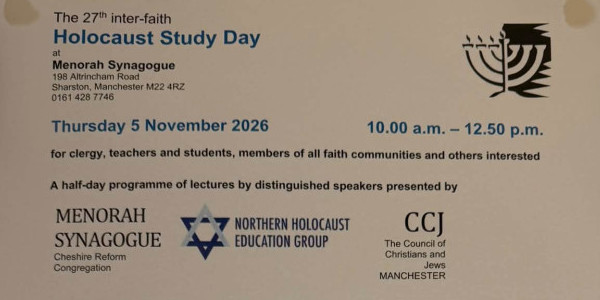
Źródło: Relacja s. Katarzyny Kowalskiej
Menorah Synagogue w Manchesterze (reformowana kongregacja Cheshire Reform Congregation)
(Eng below)
Dziś, 5 listopada 2026 roku, w Menorah Synagogue w Manchesterze, reformowanej kongregacji Cheshire Reform Congregation, odbył się 27. międzyreligijny Dzień Studiów nad Zagładą. Organizatorami byli Menorah Synagogue, Northern Holocaust Education Group i Rada Chrześcijan i Żydów w Manchesterze (CCJ).
Wydarzenie co roku uzupełnia styczniowe obchody Dnia Pamięci o Holokauście, ale patrzy na Zagładę przede wszystkim z perspektywy religijnej i z nadzieją na przyszłość.
Przez całe przedpołudnie duchowni, nauczyciele, studenci i członkowie różnych wspólnot wiary słuchali żydowskich i chrześcijańskich prelegentów.
W programie znalazły się:
- s. Katarzyna Kowalska - wykład nt „Znaczenie studiów nad Zagładą dla chrześcijan”.
- świadectwo Alison Cooper o swojej Mamie Judis która w wieku 2.5 lat (!) została zabrana do Theresienstadt; i odpowiedź na nie ks. kanonika Steve’a Williamsa,
- opowieść o „Skrzypcach z Terezína” oraz wykonanie na nich muzyki przez dr. Andrew Wintera i Barbary Silverstone;
- wykład prof. Davida Balsamo o nowoczesności i Zagładzie u Z Baumana
- refleksja rabin Kath Vardi o judaizmie po Zagładzie.
Z relacji s.Katarzyny Kowalskiej
Rabinka Kath Vardi
Rabinka Kath Vardi wskazała na metaforę „szklanego kapelusza” jako obraz traumy i pamięci, które każdy Żyd dziedziczy po Szoa, czy tego chce, czy nie.
Mówiła, że po Holokauście żydostwo bardzo się zróżnicowało: przez asymilację, odrodzenie ortodoksji, judaizm postępowy i syjonizm. Każdą z tych dróg uważa za inny sposób noszenia tego samego brzemienia.
Zauważa, że wielu świeckich Żydów nadal skupia się wokół synagogi, bo modlitwa daje wspólny język na cierpienie i sens oraz łączy ich z łańcuchem pokoleń.
Przywołała rabina Davida Hartmana, który wzywał, by życie żydowskie organizować wokół Synaju (etyki, odpowiedzialności, troski), a nie tylko wokół Auschwitz.
Na koniec, odnosząc się do podziałów po 7 października, mówiła, że spór nie musi być porażką: wyzwaniem nie jest zdjęcie kapelusza, tylko budowanie bogatego żydowskiego życia, które jest czymś więcej niż przetrwaniem.
s. Katarzyna Kowalska
Ja mówiłam o tym, dlaczego chrześcijanie potrzebują dziś studiów nad Zagładą. Nie chodzi o to, by wiedzieć więcej o 1938 roku, ale o to, jak zachowujemy się w 2026. Podałam pięć powodów:
- 1️⃣ Nauka pogardy nie umarła, żyje jako odruch. Stare obrazy Żydów wracają w nowych przebraniach, w języku polityki, w mediach społecznościowych, a nawet w liturgii. Tylko ten, kto zna historię, rozpozna je i nie powtórzy.
- 2️⃣ Pamięć jest obowiązkiem ale sama z siebie nie chroni. Można więc pamiętać dla upamiętnienia, dla korzyści albo po to, żeby zapomnieć. Rzetelne studia nad Zagładą, prowadzone z żydowskimi głosami, chronią pamięć przed nami samymi.
- 3️⃣ Shoah to pytanie o tożsamość chrześcijan. Zagłada pyta Kościół nie tylko o to, jak postępować, ale o to, kim jest. Jak przypomina watykańska nota „Droga nadziei”, poznawanie judaizmu, również tego współczesnego nie jest dla chrześcijan dodatkiem, lecz drogą do zrozumienia samych siebie.
- 4️⃣ Uczymy się, kim jest bierny świadek. Większość chrześcijan w czasie wojny nie była sprawcami, lecz ludźmi, którzy odwracali wzrok. Studia nad Zagładą uczą rozpoznawać moment, w którym sami stajemy się biernymi świadkami wobec każdego, kogo odczłowiecza się na naszych oczach. Nie być obojętnym!
- 5️⃣ Dialog potrzebuje wiedzy, nie tylko dobrej woli. Ostatnie lata wystawiły relacje żydowsko-chrześcijańskie na ciężką próbę, a cierpienie po obu stronach nie zawsze zostało usłyszane. Pamięć o dzieciach Zagłady nie pozwala porównywać cierpienia, ale uczy słyszeć płacz wszystkich matek i dzieci dotkniętych wojną.
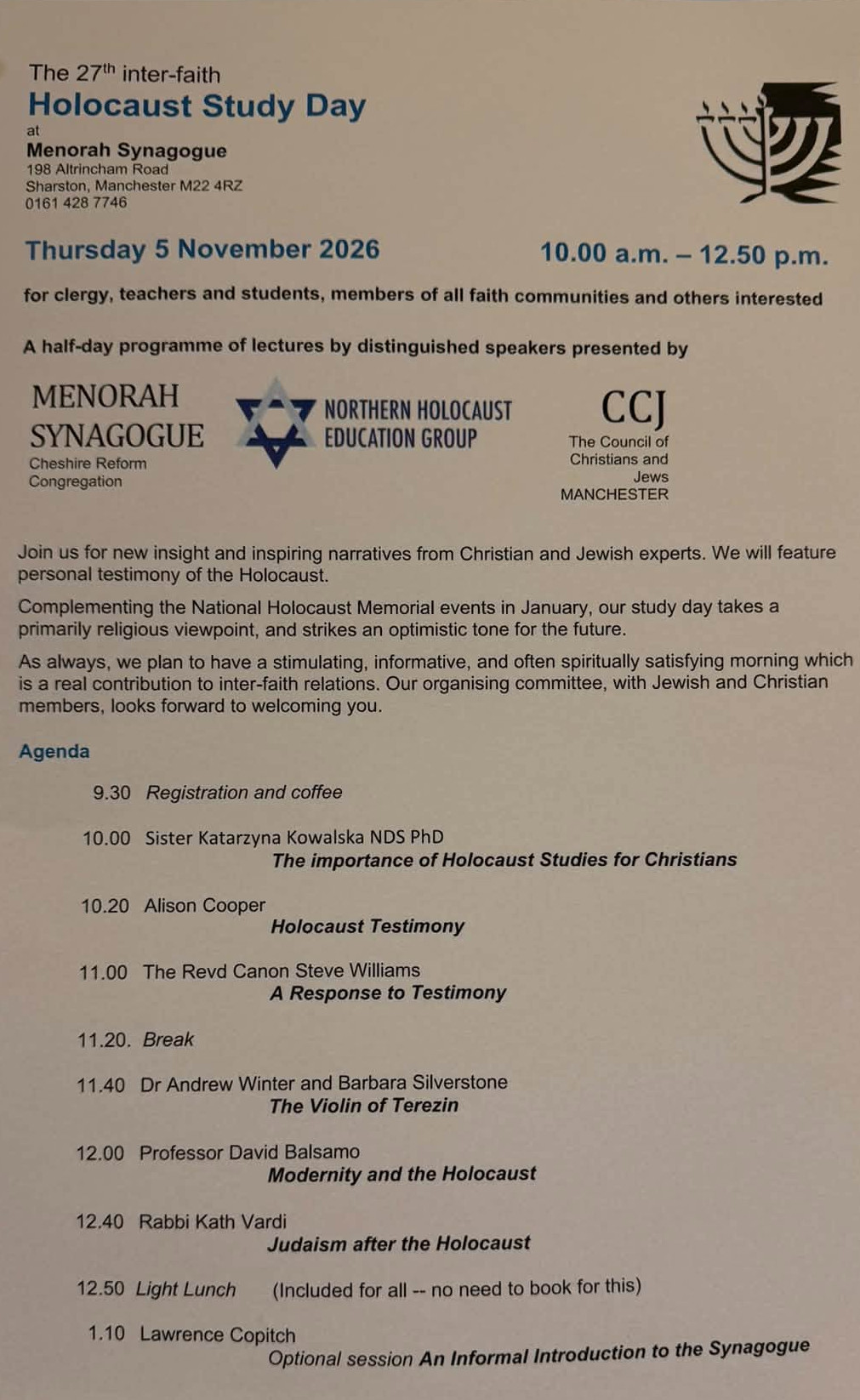
Ang
Today, November 5, 2026, the 27th interfaith Holocaust Study Day was held at the Menorah Synagogue in Manchester, which belongs to the Cheshire Reform Congregation. The event was organized by the Menorah Synagogue, the Northern Holocaust Education Group, and the Council of Christians and Jews in Manchester (CCJ). This annual event complements the January observances of Holocaust Remembrance Day but approaches the Holocaust primarily from a religious perspective and with hope for the future.
Throughout the morning, clergy, teachers, students, and members of various faith communities listened to Jewish and Christian speakers.
The program included:
- a testimony by Alison Cooper and a response to it by Canon Steve Williams,
- a story about “The Violins of Terezín” and a musical performance on them by Dr. Andrew Winter and Barbara Silverstone,
- a lecture by Prof. David Balsamo on modernity and the Holocaust in the work of Z. Bauman, and
- a reflection by Rabbi Kath Vardi on Judaism after the Holocaust.
- I was asked to deliver a lecture titled “The Significance of Holocaust Studies for Christians.”
Thank you Teresa Brittain nds for the invitation and to all organisers!
From s.Katarzyna Kowalska reflection;
Rabbi Kath Vardi
- drew attention to the metaphor of the “glass hat” as an image of the trauma and memory that every Jew inherits from the Shoah, whether they want to or not. She said that after the Holocaust, Jewish identity became very diverse: through assimilation, the revival of Orthodoxy, progressive Judaism, and Zionism.
- She considers each of these paths to be a different way of bearing the same burden. She notes that many secular Jews still gather around the synagogue because prayer provides a common language for expressing suffering and meaning and connects them to the chain of generations. She quoted Rabbi David Hartman, who called for organizing Jewish life around Sinai (ethics, responsibility, compassion) and not just around Auschwitz.
- Finally, referring to the divisions following October 7, she said that a dispute does not necessarily mean defeat: the challenge is not to take off one’s hat, but to build a rich Jewish life that is more than just survival.
s. Katarzyna Kowalska
I spoke about why Christians today need to study the Holocaust. It’s not about knowing more about 1938, but about how we behave in 2026. I gave five reasons:
- 1️⃣ The notion of contempt has not died; it lives on as an instinct. Old stereotypes about Jews are returning in new guises—in political discourse, on social media, and even in liturgy. Only those who know history will recognize them and avoid repeating them.
- 2️⃣ Memory alone does not protect. One can remember for the sake of commemoration, for personal gain, or in order to forget. Rigorous research on the Holocaust, conducted with the participation of Jewish voices, protects memory from ourselves.
- 3️⃣ The Shoah raises questions about Christian identity. The Holocaust challenges the Church not only on how to act, but also on who it is. As the Vatican’s document “The Way of Hope” reminds us, learning about lived Judaism is not an afterthought for Christians, but a path to understanding themselves.
- 4️⃣ We are learning what it means to be a passive witness. Most Christians during the war were not perpetrators, but people who looked the other way. Studies of the Holocaust teach us to recognize the moment when we ourselves become passive witnesses to anyone who is dehumanized before our very eyes.
- 5️⃣ Dialogue requires knowledge, not just good will. Recent years have put Jewish-Christian relations to a severe test, and the suffering on both sides has not always been heard. The memory of the children of the Holocaust does not allow for comparisons of suffering, but teaches us to listen to the cries of all mothers and children affected by war.
__
Northern Holocaust Education Group (NHEG)
Northern Holocaust Education Group (NHEG) was founded in recognition that the first generation of Holocaust Survivors will not be able to tell their stories in person forever.
Our aim is to ensure that future generations will continue to experience the life stories of victims of Nazi persecution and the Holocaust, in a way that will be meaningful and relevant to the issues of the present day. These life stories form a rich resource for schools, colleges, places of worship and civic authorities to use as part of their programmes about the Holocaust, discrimination and identity.
Our volunteer speakers are invited as guests to deliver a personal story of their families experience of the Holocaust and the Nazi period. We hope our presentations will spark and inspire members of the audience to stand up against hatred, discrimination and persecution of any kind.
Northern Holocaust Education Group’s (NHEG) purpose is to pass on the life stories and experiences of the victims of Nazi persecution and the Holocaust so that they are not forgotten or denied.
If you are interested in booking one of our volunteer speakers please email - administration@northernholocausteducationgroup.org.uk NHEG's work includes challenging all forms of discrimination and prejudice and createa greater understanding of the plight of refugees today.
We hope our presentations will spark and inspire members of the audience to stand up against hatred, discrimination and persecution of any kind and to oppose Holocaust denial.
NHEG provides a network of accredited speakers including those who tell their family stories and experiences before and during the Holocaust.
These resources are intended as an enrichment resource to programmes of Holocaust education. We can deliver these stories online, usually via Zoom, or, face to face as the situation allows.
Menorah Synagogue in Manchesterze (Cheshire Reform Congregation)
A vibrant progressive Jewish community in South Manchester
OUR VALUES
Menorah respects the long-standing Jewish tradition of valuing minority and dissenting opinion. Our members hold a wide range of views and express their Judaism in varying ways. However, as an organisation we agree with the following statements which are based on values expressed by the Movement for Progressive Judaism
Progressive Judaism:
treasures both Jewish tradition and Judaism’s ability to evolve in response to the contemporary world a life of integrity based on a process of informed decision making an uncompromising commitment to gender equality and inclusion, responding to the changing realities of our community seeks out new opportunities and spaces in which to welcome and engage with members, unaffiliated Jews and those with non-Jewish partners means building a just society through social action and tikkun olam, repair of the world
On Israel:
we are a Zionist congregation. We have a commitment to the existence of the State of Israel and its security. We believe that the pursuit of peace is the highest ideal and priority. We are deeply committed to democracy; human rights and social justice; and religious pluralism. we believe that Israel should be a Jewish state and a state for all its citizens.
we believe that exponents of moderate, liberal Judaism should ally with moderate liberal secularists and work together to combat both religious and secular extremism we support organisations dedicated to building bridges for peace in Israel.
Council of Christians and Jews in Manchester (CCJ
We were founded in 1942, at the height of the Second World War and the Holocaust, by Archbishop William Temple and Chief Rabbi Joseph Hertz. Her Majesty the Queen was our patron for 70 years since 1952, and His Majesty King Charles became our Patron on the first anniversary of Their Majesties' Coronation.
Our aim is for Jews and Christians to meet, to understand each other better and to create meaningful engagement between the communities. We have grown into a nationwide network of local branches around the UK, complemented by a professional team that run national programmes in education, dialogue and social action - for Rabbis and clergy, community leaders, students, policy makers, CCJ members and those of all faiths and none.
The message of CCJ is as relevant today as ever. We call on people of faith to use our diversity to challenge prejudice and persecution together so that we can build strong communities that live in dignity, understanding and fellowship.
For over 80 years, CCJ has been a leading player in interfaith engagement. We have provided an opportunity for people to come together, share ideas, learn about one another and build a stronger, more tolerant society. We provide a space to celebrate our similarities and the values that we share, while acknowledging that diversity is what makes living together so rewarding.