The Study of Saints
06/07/2026 | Na stronie od 28/05/2026
Source: Elijah Interfaith Institute
All religions recognize there are outstanding individuals, whose spiritual insight, presence and power by far surpass those of others. These individuals help create, define, drive, reform and inspire their traditions. They are the models who provide the basis for emulation for others and they are the ideal of the tradition in its concrete manifestation, in the lives of humans.
Throughout history and in the literature, the individuals under discussion have been known by many names and titles, reflecting their various offices, including prophets, founders, mystics, saints, heroes, religious virtuosos and more. Categories vary and are to a large degree a matter of convention. Their significance is ultimately a function of the measure to which they are helpful in enhancing understanding and advancing discussion.
The term “Saints” is a way of describing those outstanding individuals who have devoted their lives to the good of others, often at great personal expense, and whose connection with the spiritual world is stronger than ordinary people. Although not all religions use the term or have a clear definition of what makes a “saint”, scholars are able to identify individuals who have made an extraordinary contribution to the religion and to the lives of devotees and who are role-models for a life of devotion.
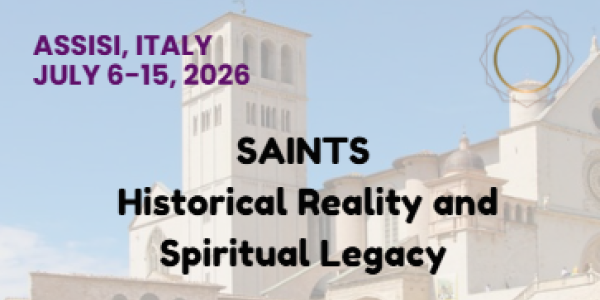
"Saints: Historical Reality and Spiritual Legacy" is the theme for this year's summer school.
Judaism does not use the category of “saint” but it is clear that the depiction of Abraham in Rabbinic literature paints him as a suitable candidate should the category be applied.
The figure of Abraham is utilized differently in each of the three “Abrahamic” religions as a paradigm for their own religious tradition. In Judaism, many rabbinic texts maintain that Abraham actually observed the entire Torah as well as rabbinic law. In the Christian tradition, his quality of faith is emphasized, and the Muslim tradition emphasizes his submission to God. This distinction is expressed even more sharply in the way the three different religions deal with the story of the near-sacrifice of Isaac. When analysing Abraham as a candidate for “Sainthood,” Professor Barry Levy concluded that there is no one legitimate interpretation of the Biblical stories. The interpretations are subjective, using as much integrity as possible in dealing with the characters in the context of each generation and community. This is similar to the perspective of rabbinic literature, which is not uniform, but an anthology of many different views, sometimes even mutually irreconcilable with each other.
Esther is another candidate for sainthood in Judaism from Biblical literature, but there is less consistency in the way she is depicted.
The Biblical story of Esther presented very serious problems to rabbinic Judaism because of her relationship with King Ahasuerus. The Talmud, and later rabbinic literature, in some cases reinterpreted and reshaped the story of Esther to preserve her image as a heroine. In other cases, her behavior was rationalized to justify her relationship with the king for the sake of saving her people. The story of Esther raises the question about whether the saint needs to have lived a life beyond reproach and whether her devotional life is more significant than her contribution to national or societal concerns.
Both these cases highlight the difficulty in taking characters from the sacred texts and elevating them to the status of “saint’ – a post-biblical concept. One of the topics to be explored in the forthcoming Elijah Summer School, to be held in Assisi, the birthplace of St Francis, is separating myth from “history” and whether such differentiation is useful or relevant. While immersed in the historical setting of this man, venerated in Christianity and beloved and admired well beyond any one religious tradition, we will try to understand how his influence and importance superseded history even while grounded in it.
In the Elijah Summer School, we will examine “saints” from the sacred sources and from mediaeval and modern history in six different religious traditions. From the Hindu Ramakrishna to Sikh, Buddhist, Muslim and Jewish candidates for sainthood, circling back to St Francis as our clear archetype, we will study the lives and influence of these outstanding individuals and ask the difficult questions about whether their elevation to this category is helpful to us, twenty-first century seekers of spiritual guidance.