New Treblinka research uncovers forgotten role of women in 1943 death camp revolt
27/06/2026 | Na stronie od 27/06/2026
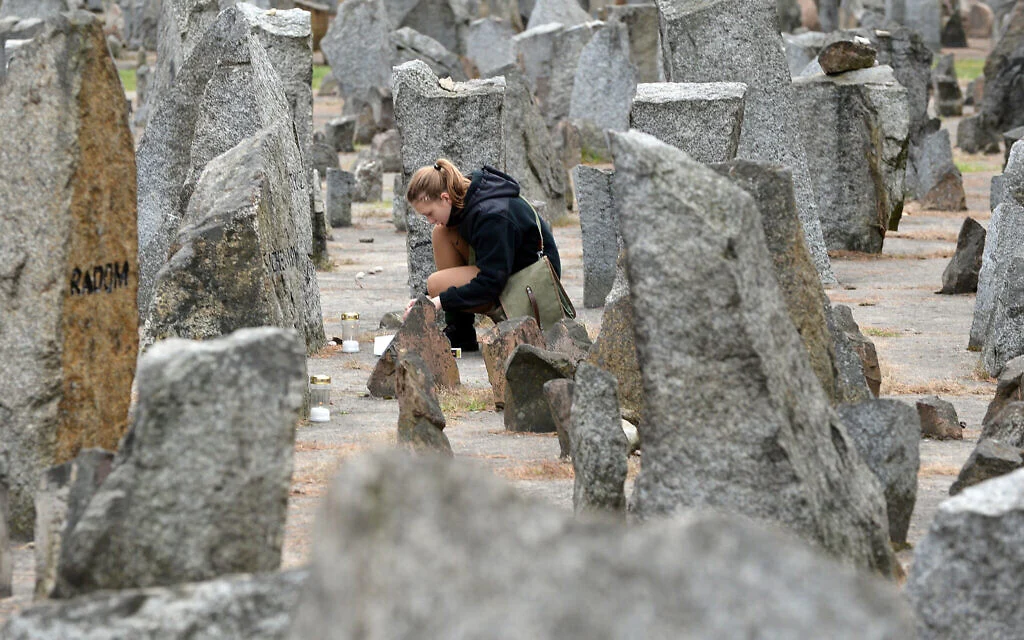
A Polish scout lights a candle in front of the monument of Treblinka World War II-era Nazi death camp on October 2, 2013 in Treblinka. (JANEK SKARZYNSKI / AFP)
Source: The Timesnof Israel
Apart from two female survivors, all testimony about Treblinka came from male inmates. In a new book, historian Chad S.A. Gibbs restores Jewish women’s overlooked place in camp resistance
By Matt Lebovic
For eight decades, the experiences of women who resisted the Nazis at the death camp Treblinka were almost entirely erased from Holocaust memory. But in a seminal book published earlier this month, historian Chad S.A. Gibbs demonstrates that female prisoners played a pivotal role in resistance at Treblinka, the German-built extermination center in occupied Poland where 925,000 Jews were murdered in the Holocaust.
“Survivors and historians evaded discussion of women’s lives at Treblinka, at times, out of a desire to protect women survivors from the latter-day judgment of others,” wrote Gibbs, director of the Zucker/Goldberg Center for Holocaust Studies at the College of Charleston.
“These same surviving men and some of their peers also avoided the topic of women’s lives and what they endured at Treblinka in order to protect themselves from the psychologically damaging effects of retelling,” said Gibbs.
In “Survival at Treblinka: Geography, Gender, and Social Networks in Jewish Resistance,” Gibbs zooms in on the “gendered geography” of Treblinka. He is especially interested in how groups of prisoners — including women — “carved out places of resistance” underneath the perpetrators’ noses.
The book is filled with examples of how women “used various A prime example of women’s history being erased at Treblinka was the previously undocumented camp brothel, wrote Gibbs. With male survivors omitting the brothel from their testimony, the heroism of Jewish women who clandestinely acquired weapons at that harrowing site has not been remembered — until nowdeceptions to take control of geography,” whether for the purposes of smuggling food, providing information, or preparing to offer medical aid in case of a revolt.
“Jewish women at Treblinka fought back in self-led, spontaneous moments of armed and unarmed resistance, organized to protect their own lives and those of others at great peril, and endured the eye of hell to arm an insurrection which they almost certainly knew might bring about their own deaths,” wrote Gibbs.
In the years ahead, Gibbs said Holocaust studies will see a “reevaluation” regarding “the less seemly sides of the lives of survivors whom we hold as heroes,” he told The Times of Israel.
A prime example of women’s history being erased at Treblinka was the previously undocumented camp brothel, wrote Gibbs. With male survivors omitting the brothel from their testimony, the heroism of Jewish women who clandestinely acquired weapons at that harrowing site has not been remembered — until now.
"As we enter the post-memory era — the years after living witnesses have left us — we will be able to ask some hard questions of the sources they left behind that would be almost impossible to ask of a living elder survivor. In this regard, we will learn more about the lives of women across occupied Europe, about violence between victims of the Holocaust, about queer lives under Nazism, and so much more,” said Gibbs.
Those who made it out
The culmination of resistance at Treblinka took place on August 2, 1943. After seizing weapons from the camp armory, prisoners set fire to buildings and stormed the main gate. Of some 200 prisoners who escaped that day, historians generally accept a decades-old estimate that 68 escapees survived to see the end of World War II.
Through years of research, however, Gibbs expanded the list of known Treblinka survivors to 262 individuals, each of whose name and biographical information appears in the book’s 42-page “Survivors of Treblinka” appendix.
“Increasing the number of survivors from 68 to 262 in the context of a place that killed as many as 925,000 people in no way alters the overwhelming lethality of Treblinka,” wrote Gibbs.
In recent weeks, the researcher’s approach has been lauded as “revelatory” and “genuinely exciting” by other Holocaust historians.
“Regrettably, it is unlikely that the omitted names of women murdered at Treblinka or the identities of many more who survived will ever be recovered,” wrote Gibbs.
“Even after more than 80 years of research, writing, and oral history collection, Bronka Sukno and Sonia Lewkowicz remain the only two confirmed women survivors of the Treblinka revolt,” he wrote.
The comeback of testimony
In addition to Sukno and Lewkowicz, at least eight additional women made it out of Treblinka during the revolt, said Gibbs. However, the escapees were not in the death camp long enough to witness and record examples of resistance, he said.
“The resulting scarcity of historical sources created by women means that research must be carried out almost entirely in sources created by men,” wrote Gibbs.
A US military veteran who was wounded in Iraq, Gibbs has interviewed survivors for the USC Shoah Foundation. Despite assumptions that oral testimony is of central importance to Holocaust historians, Gibbs told The Times of Israel this has not typically been the case.
“We are recovering, as historians, from a long distrust of oral history as a source base,” said Gibbs. “Many historians of the previous generation privileged written documents above all else, doubting the veracity of faulty human memory. More recent work is using a great deal of oral testimony and learning just how useful it will be if you ask the right questions of these sources and attempt to back them up, as needed, with a wider analysis,” said Gibbs.
A case in point regarding Treblinka testimony is survivor Eddie Weinstein. Although Weinstein wrote a memoir in 1947, the document was not published until 2008. The memoir contains content about women at Treblinka that did not appear in previous histories of the camp, including Weinstein’s account of forced sexual exploitation.
“We also heard that the Germans spared pretty women, whom they kept around for gang rape by German officers and Ukrainians, and murdered them,” wrote Weinstein.
“Only men were employed in the parts of Treblinka where I worked. Once, someone called my attention to a young woman dressed as a teenage boy, who was sorting clothes with us. I don’t know how long she survived,” wrote Weinstein.
In addition to acquiring weapons at the camp brothel, Gibbs demonstrates how women resisted the Nazis at the infirmary and other Treblinka sites. Women in the kitchen, for example, “played a vital, if seldom discussed, role in [distributing arms],” said Gibbs.
In “Survival at Treblinka,” Gibbs juxtaposes oral testimonies and other evidence to explain how Jews in disparate parts of the camp managed to manipulate Ukrainian guards and their German SS masters. With whom a prisoner associated, and where he or she was assigned to work, were key determinants between death and survival.
“Escape and resistance at Treblinka relied upon social networks and geographic place-making strategies,” said Gibbs. “Jewish prisoner leadership created places of resistance by uniting like-minded prisoners and providing them with the geographic access and materials needed to safeguard the lives of co-conspirators and, later, to rise up against their captors.”