‘God’s wish’: Religious Zionist rabbi still crusading for peace with the Palestinians
02/06/2026 | Na stronie od 02/06/2026
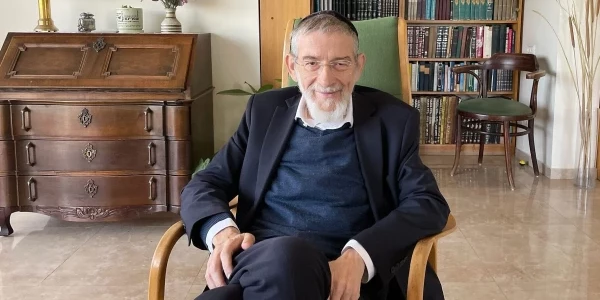
Main image: Rabbi Michael Melchior in his apartment in Jerusalem on May 14, 2026. (Rossella Tercatin/Times of Israel)
Source: The Times of Israel
By Rossella Tercatin
Rabbi Michael Melchior, 72, is constantly confronting the question of the ultimate aim of a Jewish state. The eighth generation in a line of Danish rabbis, Melchior chose to move to Israel from Denmark in 1986.
“Is the final purpose of a Jewish state just to achieve security [for the Jewish people]? Or a much higher one — a state sanctifying the name of God in the eyes of Jews and also in the eyes of the world, led by the ideas of justice and righteousness, all principles that the Torah describes as the purpose of us going into the Land?” Melchior asked.
To most Israelis above a certain age, the rabbi is known as the chairman of the long-defunct Meimad, a moderate Religious Zionist party that was associated with the Israeli left and supported the peace process with the Palestinians in the 1990s and early 2000s. The name Meimad was the Hebrew acronym of the words “A Jewish state, a democratic state.”
For a decade, Melchior served in the Knesset and in various ministerial positions. He was involved in some of the most high-level decisions regarding the peace process and national security, supporting and watching different attempts to end the conflict with the Palestinians bloom — and wilt.
“[Our] God is the God of justice, and this is how we want our society to be looked at in the world, because the biggest sin in Judaism is to desecrate the name of God,” Melchior said. “Is that a consideration at all when you sit in the security cabinet? I know a little bit about it, because I’ve been there.”
The Times of Israel recently spoke with Melchior on the phone twice and then joined him in his apartment in Jerusalem. The rabbi is still optimistic about the trajectory of Israel and the Middle East, stating that despite two and a half years of wars triggered by the October 7, 2023, Hamas atrocities, peace is possibly closer than ever.
Today, Melchior rejects the “left-wing” label. He is, however, still working to promote a different way of bringing religious values into public service and discourse, at a time when the Religious Zionist community is increasingly associated with the hard right.
“Today, we work pursuing peace based on a religious perspective, rather than a left-wing one,” he said.
What are religious values?
According to Melchior, a sore lack of understanding of religious identity and values across both the Israeli and the Palestinian populations was one of the most significant factors behind the failure of the peace process, as well as the public’s alienation from it.
‘People might have been willing to give up land, but not who they were’
“Part of the failure of Oslo was that it included the [largely nonreligious] peace camp, but did not attempt to include the more traditional and religious community,” Melchior posited, referring to the US-brokered agreements signed in the 1990s between Israel and the Palestinian Liberation Organization (PLO) that created the Palestinian Authority.
“The tent of Oslo became too narrow, and therefore could not succeed on the Israeli side or the Palestinian side,” he said. “If you use peace in order to go against the DNA of a society, as part of [an attempt to promote] secularization, then you’re not going to achieve either peace or secularization. People might have been willing to give up land, but not who they were.”
According to Melchior, the Camp David process led by Prime Minister Ehud Barak a few years later was even worse.
“I knew very well [prime minister and Oslo architect] Yitzhak Rabin, may his memory be a blessing, and I could talk to him about these issues,” he recalled. “I sat in the cabinet of Ehud Barak, and he took all the most sensitive religious issues and messed them up.”
To promote a different approach in 1999, Melchior established Mosaica, working with the late Sheik Abdullah Nimer Darwish, founder of the Islamic Movement in Israel. The Islamic Movement’s political wing later became the Ra’am party, which in 2021 was the first Arab-majority party in decades to join a governing coalition in Israel.
According to the rabbi, today Mosaica gathers hundreds of religious leaders, both Jewish and Muslim, in Israel, the West Bank and beyond.
“We work behind the scenes and do not advertise our successes,” Melchior said. “I can say thousands of lives have been saved through our work.”
He recalled how, on October 7, 2023, his phone would not stop ringing with calls and messages from imams from both Israel and the West Bank, saying they were going to speak at mosques and communities not only to dissuade people from joining the attacks, but also calling them a desecration of Islam.
‘I can say thousands of lives have been saved through our work’
“This is exactly what happened,” Melchior said. “It was a proof to me, and it’s still the case, that our coalition stands on very solid ground. Around the world, most Jewish-Muslim dialogue initiatives evaporated on that day.”
A different path for Religious Zionism
Melchior admitted that most people who identify as Religious Zionists in Israel today support ideas that are very far from his Torah of tolerance.
“People in the religious camp have somewhat gotten very obsessed about the issue of land,” he said.
“I myself moved to Israel because I feel that our connection to the land is both historic and religious, that us coming back to the land is the fulfillment of a God-given promise,” he added. “At the same time, there is another people living in the land, and I believe that this is also something which God wished to be so — otherwise it wouldn’t be so.”
According to Melchior, “God’s wish is ultimately for us to make peace; there is no Jewish prayer which doesn’t end in making peace.”
The rabbi pointed out that his view is backed by many biblical and Jewish sources.
“Abraham, Isaac and King Solomon gave up land in order to make peace,” he said. “The Talmud also explains that people did not need to [reside] in Samaria [the ancient kingdom of Israel] if socioeconomic [conditions would not allow it].”
“I’ve been in different debates with rabbis who oppose this [view], and I’ve never heard a substantial answer to those arguments,” he added. “It’s more a question of feelings, and with feelings, I think we can deal with.”
‘God’s wish is ultimately for us to make peace; there is no Jewish prayer which doesn’t end in making peace’
According to Melchior, even hardline rabbis are ready to be more flexible when they hear a sincere desire for peace among Muslim leaders.
“The Jewish dream is that one day [the land] should all be ours,” he said. “However, when [these rabbis] see Muslim leaders who also have that dream saying that we have to put it aside, because peace and hope for future generations are bigger dreams, and are writing authoritative fatwas [rulings on Islamic law] about this, they understand there is something which we can maybe work together.”
Melchior also said that many of those hardline rabbis consider the dramatic increase in extremist settlers’ violence against Palestinians completely unacceptable.
“They do not always know what to do with it, but they understand this,” he maintained.
Data released earlier this year from the Israel Defense Forces and Shin Bet shows that settler attacks rose by 27% in 2025 compared to the previous year. The left-leaning Yesh Din registered 378 incidents during the recent 40 days of hostilities with Iran alone, with eight Palestinians killed and 200 injured.
“Settler violence can only grow when there is legitimization for it in the general settler community and in the government circles,” Melchior said. “Even those who condemn it do not take efficient means to stop this disgrace.”
“We are all responsible as a society,” he added. “The question is what we do with it. Again, in my mind, the best solution is to make peace and include the Religious Zionist camp.”
Rising antisemitism felt in the Diaspora
Melchior still heads the rabbinical court of Scandinavia, and, until recently, he served as the chief rabbi of Norway. Now his son Joav has taken over the position; another son, Jair, is the chief rabbi of Denmark.
Asked about how the Jews in Scandinavia have been faring amid the increase in antisemitism registered by many communities in the world, the rabbi said that it depends on whether one looks at the glass as half-full or half-empty.
“First of all, it disturbs me that when people ask about the Jewish community, it is always about antisemitism,” he said. “Jewish life is flourishing. After October 7, even more people want to connect with each other and strengthen Jewish life.”
At the same time, the rabbi acknowledged that antisemitism is a problem in Scandinavia.
“There is antisemitism, especially in Norway, verbal antisemitism, more than physical antisemitism,” he said.
“Mostly, it is antisemitism in the form of very vicious attacks against Zionism,” he explained. “I am not of those who say that people who disagree with Israel are antisemites, but demonization of Israel is a red line. People in the Jewish community have found themselves feeling isolated because they’re Jewish, and that is intolerable, not only for the sake of the Jews, but for the sake of any healthy society.”
A religious minority
Melchior noted that support for the ideas he promotes has never been especially popular among the religious community in Israel.
“We were always a small party; I was mostly the only member [in the Knesset],” he noted. “However, today, several leading people in our party sit in the Knesset in different parties. We haven’t diminished; quite the opposite.”
Asked if he is bothered by the fact that a party that embodies a very different approach to religious values calls itself Religious Zionism, he said that everyone is entitled to their opinion.
‘Today, several leading people in our party sit in the Knesset in different parties’
“Maybe it bothers me that by calling themselves Religious Zionism, they want to take a monopoly on Religious Zionism,” he said. “For sure, they do not have it, since according to the polls, they might not even pass the threshold.”
“Of course, they sit in the government and have a lot of influence,” he added. “But there are a lot of rabbis who support them with whom it is possible to have a serious dialogue around these issues.”
Melchior said that he understands why Israelis are scared and tend not to trust the two-state solution anymore after the deep trauma left by the October 7 invasion and massacre.
For him, however, the two-state solution remains the framework to pursue. He explained that after so many decades of conflict, he does not believe “in the utopia that Israelis and Palestinians can live together in one state.”
The rabbi stated that today there is a real, viable possibility of making peace with the whole Arab and Muslim world, “a true peace between religions supported not by 30 or 40% of the people but by 90 or 95%.”
The rabbi also works to combat polarization within the country and bring together Jewish Israelis from different religious backgrounds through the other organization he established, the educational network Meitarim.
“We started off with two schools,” he said. “Today we have 180 institutions in our framework.”
“One could say that things are going the wrong direction, but I can show that they are going the right direction,” he added. “There’s a lot of hope for the future.”