When a nun is knocked down in Jerusalem’s Old City, help her!
Violence against Christians and Muslims, and the silence surrounding it, is corroding the very Jewish values we claim to defend
06/05/2026 | Na stronie od 07/05/2026

Still from footage that shows a nun being assaulted by a man in Jerusalem on April 28, 2026, released by the police two days later. (Israel Police)
Source: Peta Pellach Blog, The Times of Israel /recording inside/
Peta Pellach
When I saw the video of a Jewish man intentionally and viciously pushing down a nun in the Old City of Jerusalem earlier this week, and then returning to kick her while she lay on the ground, I was sickened. What made me feel equally ashamed was the other Jewish man who stood there and looked on, doing nothing.
Both these men had violated the Torah in so many ways. They brought shame on our people and thus, shame on God’s name – chillul Hashem.
Sadly, this incident was not an isolated one. The desecration of Christian sites by Jews who claim in some way to be upholding Judaism, spitting on Christians, and disrespectful slanders of Islam and the Prophet Muhammad are frequent. The claim that they are born out of fear and ignorance no longer seems sustainable. In many cases, they come from a sense of self-righteousness and superiority – characteristics that the Torah abhors.
I was brought up to believe that, in Judaism, we did not talk about “rights,” but about “responsibilities.” Nevertheless, our responsibilities to uphold the dignity of the other and to pursue justice bestows, albeit indirectly, rights on others in our society. In the same vein, we should be able to count on others to behave towards us in the same way and uphold our “rights.” Our rights and responsibilities are reciprocal.
The basis of demanding respectful behavior towards others is that every person is created in the Divine image (Genesis 1:26). We are urged to see the Divine in others and our treatment of other people is the best indicator of our respect and awe for the Divine.
That ideal is upheld by the Torah’s legal system. “One law for you and the stranger” is a biblical principle (Exodus 12:49, Numbers 15:15-16) emphasizing equal justice and legal rights for both native-born citizens and resident foreigners.
It is no surprise that the early liberal thinkers drew heavily on the Tanakh as they developed their theories of human rights, and, in the 20th century, the UN Declaration of Human Rights was based on values derived from Jewish (and Christian) sources.
It opens, “All human beings are born free and equal in dignity and rights” (UDHR, Article 1). This is an article of faith. It is shared by secular and religious thinkers, but its earliest expression is in the Torah.
The declaration is infused with ideas found in the Torah, especially concepts of justice which go beyond the procedures in a courtroom and extend into every aspect of social life.
The UN General Assembly has also passed a Declaration on the Human Right to Peace, reflecting the value in the Torah to seek peace and pursue it.
There can be no basis for suggesting that human rights are not part of Jewish thinking, even if we prefer the language of responsibility, focusing on the duties of the person with the power to bestow rights rather than on the person seeking protection or benefits.
What I have said here about Judaism is relevant also for our daughter religions, Christianity and Islam, both of which are based on responsibilities and upholding human dignity. All our religions believe that human beings are all descended from one original human being, who was brought to life with the breath of the Divine (Genesis 2:7).
Yet, watching what is going on in the world today, the dehumanization, the vilification, the demonizing of the other, it seems that our basic religious values are being ignored or distorted.
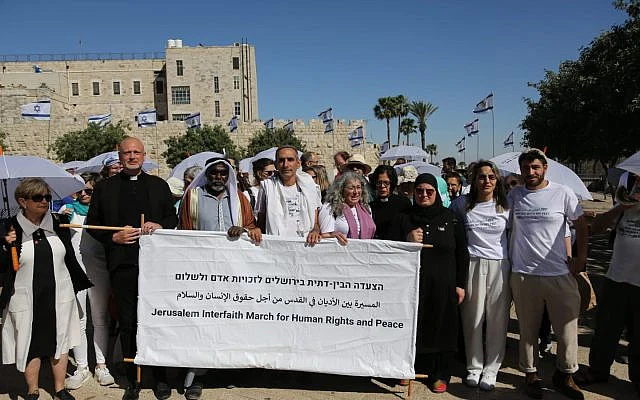
Last year’s Interfaith March for Human Rights and Peace. (Jacob Lazarus. Used with permission)
There is nothing more urgent at the moment than for us to stand together and declare that the sorts of behaviors we are observing are abhorred by our religions. People of faith, particularly religious leaders, need to be visible in their condemnation of all that they know is wrong.
The bystander who watched the nun being viciously attacked and did nothing was violating the commandment not to stand idly by while blood is spilled (Leviticus 19:16).
We have been relentless in our condemnation of those who stood by during the Shoah, labelling the bystanders as guilty of the atrocities perpetrated. It began when they did not stand up as the rights of Jewish people were gradually eroded or when small acts of violence took place.
We may not stand idly by, watching the erosion of our religious values.
This year will be the fourth year that Christians, Muslims, Jews, Druze, and others march in the streets of Jerusalem in the Interfaith March for Human Rights and Peace.
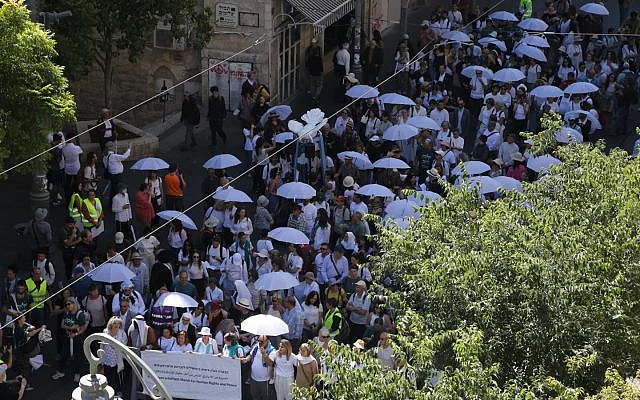
Religious leaders and communities in the streets of Jerusalem, 2025. (Jacob Lazarus. Used with permission)
-----
About the Author
A fifth generation Australian, Peta made Aliyah in 2010. She is Director of Educational Activities for the Elijah Interfaith Institute, secretary of the Jerusalem Rainbow Group for Jewish-Christian Encounter and Dialogue, a co-founder of Praying Together in Jerusalem and a teacher of Torah and Jewish History. She has visited places as exotic as Indonesia and Iceland to participate in and teach inter-religious dialogue. She is active in Women Wage Peace, Israel's largest grass-root peace movement, promoting and demanding women's involvement in negotiations. Her other passions are Scrabble and Israeli folk-dancing.
---------------------
Tłumaczenie za Postem Towarzystwa Polsko-Izraelskiego
Kiedy na Starym Mieście w Jerozolimie zostanie powalona zakonnica, pomóż jej!
My, Żydzi, nie możemy biernie przyglądać się rosnącej liczbie żydowskich ataków na chrześcijan i muzułmanów oraz erozji naszych własnych wartości religijnych
Kiedy na początku tygodnia zobaczyłem nagranie, na którym Żyd celowo i brutalnie powalił zakonnicę na Starym Mieście w Jerozolimie, a potem wrócił, by ją kopnąć, gdy leżała na ziemi, zrobiło mi się niedobrze. Równie zawstydzony poczułem się, gdy zobaczyłem drugiego Żyda, który stał tam i przyglądał się temu bezczynnie.
Obaj ci mężczyźni naruszyli Torę na tak wiele sposobów. Przynieśli wstyd naszemu ludowi, a tym samym hańbę imieniu Boga – chillul Haszem .
Niestety, ten incydent nie był odosobniony. Profanacja miejsc chrześcijańskich przez Żydów, którzy twierdzą, że w jakiś sposób popierają judaizm, plucie na chrześcijan i obraźliwe oszczerstwa wobec islamu i proroka Mahometa są częste. Twierdzenie, że wynikają one ze strachu i ignorancji, nie wydaje się już uzasadnione. W wielu przypadkach wynikają one z poczucia własnej wyższości i samozadowolenia – cech, których Tora się brzydzi. Wychowano mnie w przekonaniu, że w judaizmie nie mówimy o „prawach”, lecz o „obowiązkach”. Niemniej jednak nasza odpowiedzialność za godność drugiego człowieka i dążenie do sprawiedliwości nadaje, choć pośrednio, prawa innym członkom naszego społeczeństwa. Podobnie powinniśmy móc liczyć na to, że inni będą się wobec nas zachowywać w ten sam sposób i przestrzegać naszych „praw”. Nasze prawa i obowiązki są wzajemne.
Podstawą wymagania szacunku wobec innych jest to, że każdy człowiek został stworzony na obraz Boga (Rdz 1,26). Jesteśmy wezwani do dostrzegania Boskości w innych, a nasze traktowanie innych ludzi jest najlepszym wskaźnikiem naszego szacunku i podziwu dla Boskości.
Ideał ten jest podtrzymywany przez system prawny Tory. „Jedno prawo dla ciebie i dla cudzoziemca” to zasada biblijna ( Wyjścia 12:49 , Liczb 15:15-16 ), kładąca nacisk na równe prawa i prawa zarówno dla rodowitych obywateli, jak i obcokrajowców mieszkających w kraju.
Nie dziwi fakt, że pierwsi myśliciele liberalni w dużej mierze opierali się na Tanachu, rozwijając swoje teorie praw człowieka. A w XX wieku Deklaracja Praw Człowieka ONZ opierała się na wartościach zaczerpniętych ze źródeł żydowskich (i chrześcijańskich).
Zaczyna się od słów: „Wszyscy ludzie rodzą się wolni i równi pod względem godności i praw” (PDPC, artykuł 1). Jest to artykuł wiary. Podzielają go zarówno myśliciele świeccy, jak i religijni, ale jego najwcześniejszy wyraz znajduje się w Torze. Deklaracja ta jest przesiąknięta ideami zawartymi w Torze, zwłaszcza koncepcjami sprawiedliwości, które wykraczają poza procedury sądowe i mają zastosowanie w każdym aspekcie życia społecznego.
Zgromadzenie Ogólne ONZ uchwaliło również Deklarację o prawie człowieka do pokoju, odzwierciedlającą zawartą w Torze wartość poszukiwania pokoju i dążenia do niego.
Nie ma podstaw do twierdzenia, że prawa człowieka nie są częścią myślenia żydowskiego, nawet jeśli wolimy język odpowiedzialności, skupiający się na obowiązkach osoby posiadającej władzę nadawania praw, a nie na osobie poszukującej ochrony lub świadczeń.
To, co powiedziałam tutaj o judaizmie, odnosi się również do naszych religii-córek: chrześcijaństwa i islamu, które opierają się na odpowiedzialności i poszanowaniu godności człowieka. Wszystkie nasze religie wierzą, że wszyscy ludzie pochodzą od jednego pierwotnego człowieka, który został powołany do życia tchnieniem Boskości ( Rdz 2,7 ).
Jednak obserwując to, co dzieje się dzisiaj na świecie – odczłowieczanie, oczernianie i demonizowanie innych – można odnieść wrażenie, że nasze podstawowe wartości religijne są ignorowane lub wypaczane.
Nie ma w tej chwili nic pilniejszego niż wspólne oświadczenie, że zachowania, które obserwujemy, są odrażające dla naszych religii. Ludzie wiary, a zwłaszcza przywódcy religijni, muszą otwarcie potępiać wszystko, co uważają za złe.
Przypadkowy świadek, który widział brutalny atak na zakonnicę i nie zareagował, złamał przykazanie, aby nie stać bezczynnie, gdy przelewana jest krew ( Księga Kapłańska 19:16 ).
Nieustannie potępialiśmy tych, którzy stali bezczynnie podczas Zagłady, piętnując biernych obserwatorów jako winnych popełnionych okrucieństw. Zaczęło się od tego, że nie sprzeciwili się, gdy prawa Żydów były stopniowo naruszane lub gdy doszło do drobnych aktów przemocy.
Nie możemy stać bezczynnie, przyglądając się erozji naszych wartości religijnych.
W tym roku już po raz czwarty chrześcijanie, muzułmanie, Żydzi, Druzowie i przedstawiciele innych wyznań przemaszerują ulicami Jerozolimy w Międzyreligijnym Marszu na rzecz Praw Człowieka i Pokoju.
Peta Jones Pellach
źródło: The Times Of Israel